Pretend you know nothing about “A Christmas Carol”. Based on just its title, what is Charles Dickens’s novella about? Probably Christmas.
Say you discover the novel takes place on Christmas Eve and Christmas Day. The main character is led by three spirits representing Christmas Past, Christmas Present, and Christmas Yet to Come. What’s the story about? Certainly Christmas, right?
Before we settle that, let’s meet Ebenezer Scrooge.
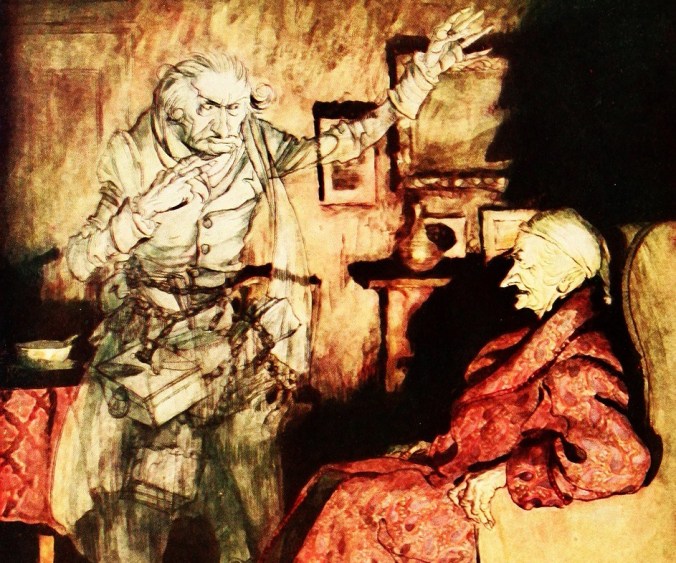
Scrooge’s Perennial Problem
Odds are, you’ve met before. Petitioned for Christmas Day off, since it’s only once a year, Scrooge complains, “A poor excuse for picking a man’s pocket every twenty-fifth of December!” He may as well be asking himself, when he says to his nephew Fred, “What’s Christmastime to you, but a time for paying bills without money; a time for finding yourself a year older and not an hour richer; a time for balancing your books and having every item in ’em through a round dozen of months presented dead against you?”
Christmas isn’t the only day Scrooge has problems. His only friend, his business partner Marley, has been dead for seven years. Both made it their business to wrest money from humanity, not contribute to it. Scrooge hides behind his business to avoid others. When charity fundraisers suggest Scrooge should be more aware of the poor’s plight, he replies, “It’s not my business…. It’s enough for a man to understand his business and not to interfere with other people’s. Mine occupies me constantly. Good afternoon, gentlemen!”
The lessons Scrooge learns apply to any day of the year. This story is set on Christmas because it’s the one day others object to his ordinary habits.
What the “Carol” Isn’t About
What makes Christmas different than any other day? According to Fred, “…I am sure I have always thought of Christmas time, when it has come round–apart from the veneration due its sacred name and origin, if anything belonging to it can be apart from that–as a good time: a kind, forgiving, charitable, pleasant time: the only time I know of, in the long calendar of the year, when men and women seem by one consent to open their shut-up hearts freely, and to think of people below them as if they really were fellow-passengers to the grave, and not another race of creatures, bound on other journeys. And therefore, uncle, though it has never put a scrap of gold in my pocket, I believe that it has done me good and will do me good; and I say, God bless it!”
Something about Christmas makes men behave better, Fred believes, but what? After all, Scrooge doesn’t behave better on this day. Fred doesn’t say what, and actually avoids discussing part of Christmas: “the veneration due its sacred name and origin, if anything belonging to it can be apart from that.” It’s odd to avoid the veneration due the holiday while arguing that it deserves special attention.
Marley too, during his posthumous visit to Scrooge, mentions Christmas’s special status. “At this time of the rolling year…I suffer most. Why did I walk through crowds of fellow-beings with my eyes turned down, and never raise them to that blessed Star which led the Wise Men to a poor abode? Were there no poor homes to which its light would have conducted me!”
We ought to follow the Wise Men’s example, Marley rightfully points out, but Scripture doesn’t admire the Wise Men for visiting the poor. It admires them for visiting the Savior. Tiny Tim, the son of Scrooge’s clerk Bob Cratchit, gets it right. “He told me, coming home,” Bob tells his wife, “that he hoped the people saw him in church, because he was a cripple, and it might be pleasant to them to remember upon Christmas Day, who made lame beggars walk and blind men see.”
Christmas’s true significance gets the briefest mention, and isn’t even called by His name: Christ Jesus. His saving sacrifice and resurrection from death are never discussed. This isn’t criticism of Dickens; he was pursuing a different theme. However, the motivation to be good because “Christmas” rings hollow if we don’t acknowledge why a 2,000 year-old holiday matters today.
Not much else is said about Christmas. Bob Cratchit urges his wife to be kind, even to Scrooge, on the holiday, and Fred pities Scrooge’s opinion of it, but no one explains why. Even all three of the Christmas spirits are silent on the subject (though the Ghost of Christmas Present has much to say about other things).
The Four Ghosts of Christmas
What is the story’s theme? Why do three spirits drag Scrooge though Christmases past, present, and future? Scrooge’s studied ignorance of mankind has fashioned a massive chain which he will have to drag on his eternal travels, Marley explains. “It is required of every man…that the spirit within him should walk abroad among his fellowmen, and travel far and wide; and if that spirit goes not forth in life, it is condemned to do so after death. It is doomed to wander through the world–oh, woe is me!–and witness what it cannot share, but might have shared on earth, and turned to happiness!”
How can Scrooge escape? His allotted wandering will occur over the next three nights. Like a ghost, he can neither influence nor be noticed in any scene he visits. He can only observe how shunning Christmas costs him happiness. If all goes well, he will return a new man.
The first step in creating a new man is breaking down the old, the task of the first spirit. The Ghost of Christmas Past lets Scrooge do most of the talking as they wander his memories. Surprisingly, Scrooge weeps for his lonely youth despite keeping a lonely adulthood. He is upset by the fiancée he lost for financial gain. Most tellingly, he exults in a single Christmas party hosted by his former employer.
“‘A small matter,’ said the Ghost, ‘to make these silly folks so full of gratitude.’
‘Small!’ echoed Scrooge….
‘Why, is it not? He has spent but a few pounds of your mortal money: three or four, perhaps. Is that so much that he deserves this praise?’
‘It isn’t that,’ said Scrooge, heated by the remark and speaking unconsciously like his former, not his latter, self. ‘It isn’t that, Spirit. He has the power to render us happy or unhappy; to make our service light or burdensome; a pleasure or a toil. Say that his power lies in words and looks; in things so slight and insignificant that it is impossible to add and count ’em up: what then? The happiness he gives, is quite as great as if it cost a fortune.'”
Scrooge himself reveals what he knows is valuable: caring for others and doing what one can to make them happy. He comes away regretting his behavior toward his clerk and a boy caroler the day before.
The Ghost of Christmas Present, though the most vocal, teaches mainly by example. With the spirit, Scrooge visits not only the Christmases of his clerk and nephew, but of lighthouse keepers, sailors, miners, invalids, travelers, and more. Even those who can’t attend a Christmas party or share a Christmas meal are the better for a Christmas thought or some Christmas cheer. The poor are more blessed by Christmas than the rich because they need it more. And Scrooge needs it most.
Most of the work is done; The Ghost of Christmas Yet to Come arrives to make sure it sticks. Scrooge will die as alone as he lived, the spirit literally points out, if he continues his current course. He cannot help making others happy, either by life or by death.
Scrooge gets to work the very next morning. He restores his relationship with his nephew and takes interest in his clerk’s welfare. He has the resources to buy Bob’s family a turkey, but what really matters is that he cares about and spends time with those around him.
What Is Your Business?
This time of year, my business is to attend Christmas parties and buy enough presents not to be a Scrooge. I try not to look directly at the person ringing a bell beside a red bucket, then I drop in a bill or two to soothe my conscience. There. Now I’m not a Scrooge.
Meanwhile, I don’t find time to appreciate the holiday lights, which just remind me I have presents to buy. I don’t enjoy the company of friends; I just look forward to when I can get back home and rest. I don’t know, or really care, whether my contribution to the Salvation Army helps anyone. It’s one less thing I have to think about.
Backward, isn’t it?
“A Christmas Carol” isn’t about giving more gifts or being more busy. Business–that is, busyness–is what the story’s against. The “Carol” draws us to consider little things, not great expense. It’s care, not coin, that’s of value.
Likewise, Jesus saved us not with money, but with care. He stepped into our lives, felt our pains, and gave us His life. Our business at Christmas, and year round, is to know and meet the needs of others, like Him who did the same for us.
 Faith Focals